RFID asset management in Egypt
How organisations in Egypt use RFID to count, track and maintain their fixed assets, and how Neuoli does it on the web and on a UHF handheld, in English and Arabic.
- UHF RFID, barcode and QR
- English and Arabic
- Excel import and export
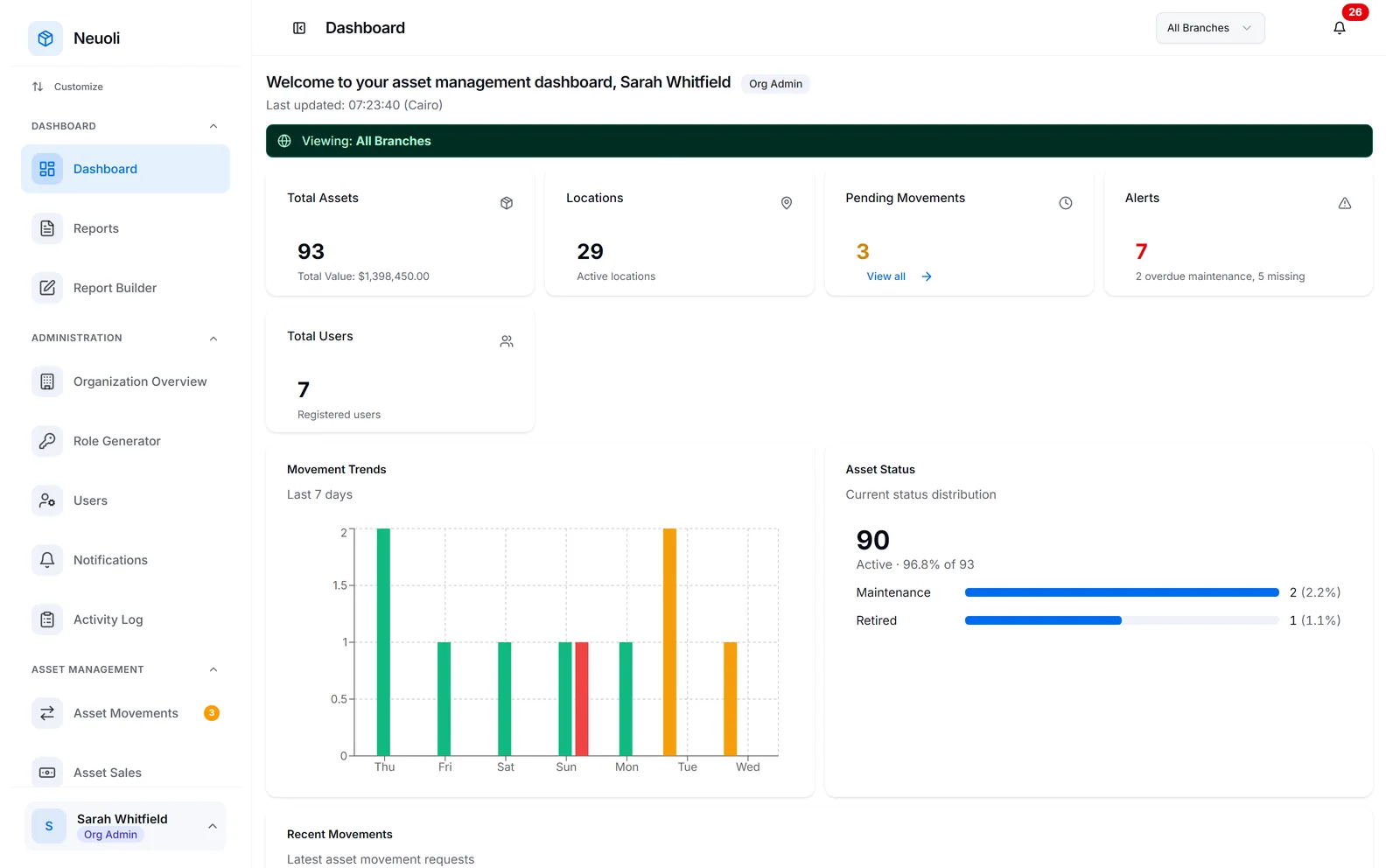
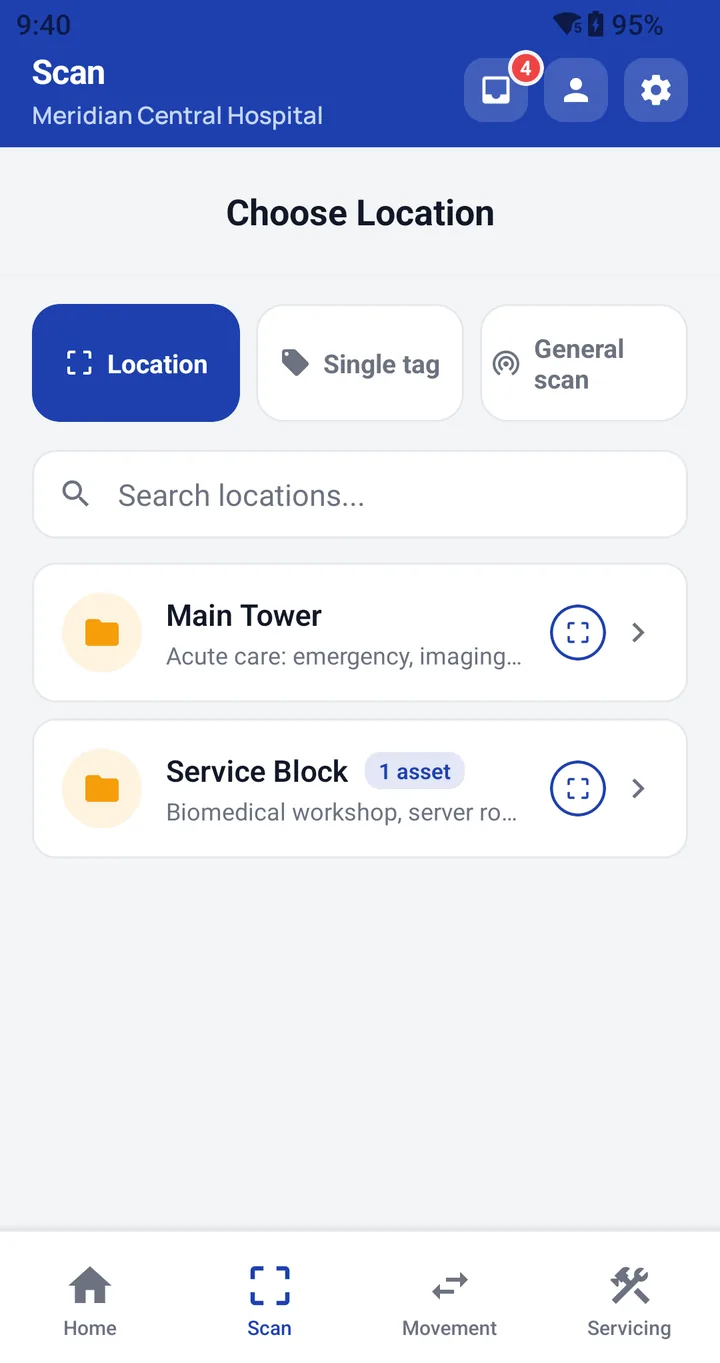
What is RFID asset management?
RFID asset management means fixing a radio-frequency identification (RFID) tag to each fixed asset and using a reader to identify those assets, instead of finding and scanning labels one at a time. Every tag carries a unique number. The software links that number to the asset record: what the asset is, where it should be, who is responsible for it, what it cost and how it is depreciating.
The practical difference shows up in the count. A barcode needs a clear line of sight: someone has to find the label, point a scanner at it, scan it and move on to the next one. A UHF RFID handheld reads every tag within range at once, including tags on items inside cabinets and boxes. The person counting walks through the room, and the software compares what was read with what the register says should be there.
RFID asset management is more than a faster count. Once every asset has a tag, the same tag identifies it when it is moved, lent, repaired, sold or written off. The register stops being a spreadsheet that is accurate on the day it is typed, and becomes a record that is updated as things happen.
RFID, barcode or QR?
Many organisations use more than one. RFID suits rooms full of furniture, equipment and IT, where reading many tags at once matters most. Barcodes and QR codes still work well when you want to look up a single item with a phone camera. Neuoli supports RFID, barcode and QR, so each can be used where it fits.
Why RFID asset management matters in Egypt
Most organisations in Egypt count their fixed assets at least once a year, usually around the financial year end, and many count more often: for internal audit, when custody of assets passes from one person to another, or when a department moves between buildings. With paper lists or a spreadsheet, a full count can take weeks, pulls people away from their normal work, and still leaves the question of whether every room was really checked.
External auditors and internal audit teams want a fixed asset register that matches what is physically on site, and an explanation for every difference: which assets are missing, which turned up in another department, and which were disposed of without being removed from the books. RFID gives you a count you can repeat as often as you need, with a recorded result for every location. See how an RFID asset inventory works, step by step.
There is an accounting side too. Egyptian Accounting Standard No. 10 covers fixed assets and their depreciation, and a complete register that has been checked on the floor is the starting point for that work. Neuoli does not decide how the standard applies to your organisation; that is for your accountants and auditors. What it does is keep the register, the depreciation and the count history they work from.
Language matters as well. Asset teams, storekeepers and technicians in Egypt often work in Arabic, while finance and management may need their reports in English. A system that only one of those groups is comfortable with tends to drift back to spreadsheets.
- Annual and surprise counts, location by location
- A result for every room: found, missing or in the wrong location
- A full activity log of who moved, approved or changed what, and when
- Arabic and English on the web and on the handheld
Tag, scan, act: RFID asset management with Neuoli
The same three steps run every day, from the first count to the final disposal.
Tag
Import your fixed asset register from Excel. The import wizard previews the sheet and flags missing values, invalid values and duplicates before anything is saved. Then fix an RFID tag to each asset. Tag numbers arrive with your bulk asset upload, so nothing is linked by hand.
Scan
On the handheld, choose the location you are counting and walk the room. Every tag in range is read at once, and each asset is marked found, missing or in the wrong location.
Act
Move an asset back or keep it where it was found, and the register updates. Missing reports are raised from the scan and tracked to closure, and exceptions become tasks for the right team.
One asset management system, from import to disposal
The RFID count is where the register gets corrected. The rest of the platform keeps it correct.
Movements
Transfers, loans and disposals follow the approval path you define. Requests come from the web or the handheld with a full timeline, overdue loans are flagged and returns are checked in.
Maintenance
Plans create work orders automatically, one-off or recurring by time, calendar or usage. Checklists, attached reports, sign-off, and replaced parts tracked with their own cost.
Depreciation
Straight-line, declining-balance or sum-of-years' depreciation. Book value is always current, and zero-book-value reports show what is fully depreciated.
Reports
Live dashboards for the organisation and every branch, ready-made and custom reports, and an API for your other systems.
Excel import and export
Bring your register in through the self-service import wizard, and export every report to Excel for finance and audit.
Bulk changes and disposals
Edit, move or sell hundreds of assets at once. An asset leaves the register only after an approved sale or write-off.
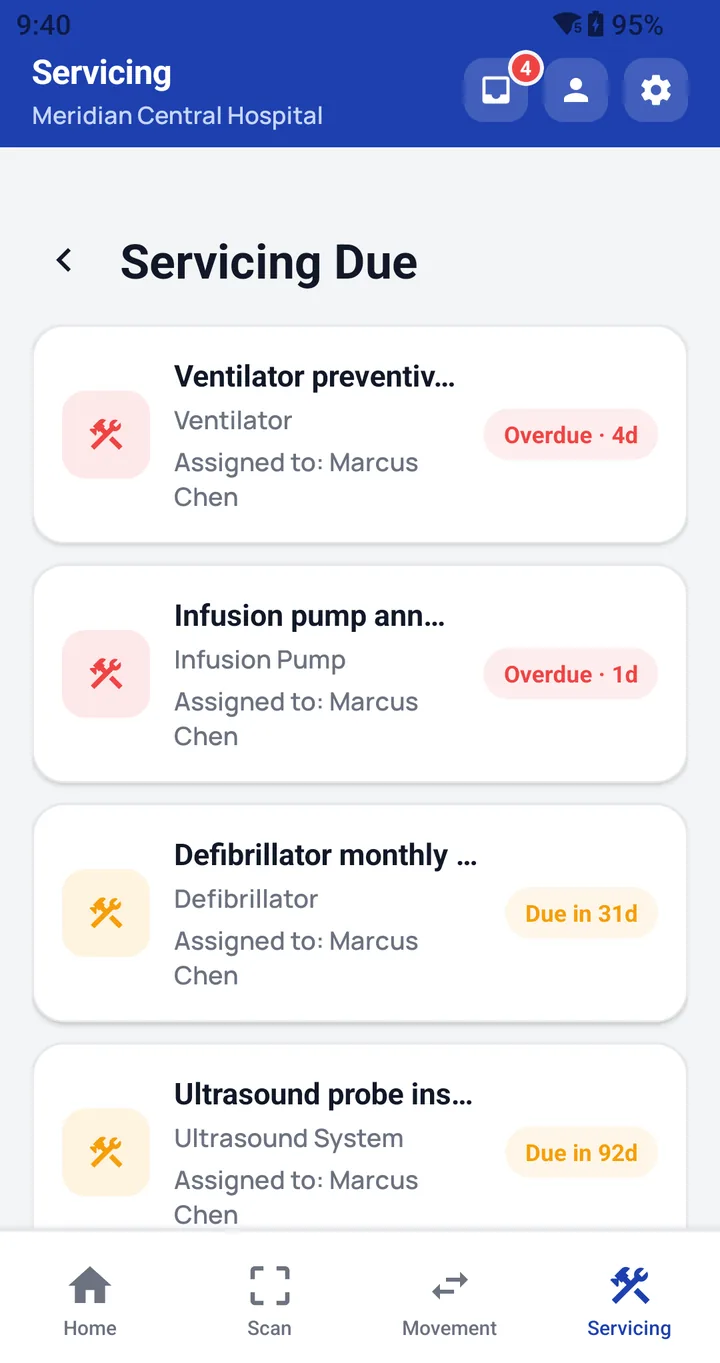
UHF RFID handhelds and asset tags
The Neuoli app runs on Android handhelds with a built-in UHF RFID reader and a scan trigger. Any Android phone with the app can scan barcodes and QR codes with its camera, and the web app runs in any modern browser.
Choosing tags
The right tag depends on the surface it goes on and the life the asset leads. As a rule of thumb:
- Label tags for furniture, fittings, and wooden or plastic surfaces
- On-metal tags for machines, IT racks, medical and kitchen equipment, where an ordinary label reads poorly
- Laundry-resistant tags for linen and other textiles that are washed
- Rugged tags for assets outdoors or in harsh areas
Two practical points. Set the handheld to the UHF frequency band permitted in Egypt: a reader set to another region's band reads poorly or not at all. And test the tags on your own assets during a pilot before you tag the whole site.
Asset management software in English and Arabic
Neuoli runs in English and Arabic, with a full right-to-left interface on the web and on the handheld. The people who count and maintain the assets and the people who report on them can each work in the language they are comfortable with.
The records are the same either way. An asset counted by a team working in Arabic appears in the same register, the same dashboards and the same Excel reports that finance reads in English.
Each sector also starts from its own template, with the right labels, asset categories and features: hospitals and clinics, hotels and resorts, offices and corporate IT, universities and schools, factories and plants, and fire-safety service companies. See the industries.
Built for organisations that answer to auditors
Every user sees only what they are responsible for, and every change leaves a trail.
Isolated customer data
Each organisation's data is kept separate from every other customer's.
Roles and department scope
Fine-grained permissions per role; users see only their branch or department.
Full activity log
Administrator actions, approvals and movements are recorded with who and when.
Approvals by design
Transfers, loans, disposals and maintenance sign-off follow your approval rules.
What drives the cost of RFID asset management
Neuoli pricing depends on the number of assets and sites. Book a demo and we will prepare a proposal for your organisation.
When you plan the whole project, budget for more than the software:
- The number of assets and sites, which sets the software proposal
- Tags for every asset, which vary by type and surface
- Enough handhelds for your counting team to cover your sites in the time you have
- The time to fix tags to assets and run the first full count
From spreadsheet to live register in four steps
Start with a live demo, then run a pilot on one site with your own register and a handheld scanner.
Set up
Choose your industry template, then add branches, departments, locations and roles.
Import
Load your existing register through the Excel wizard and fix errors before they land.
Tag
Fix the RFID tags to your assets. Tag numbers arrive with your bulk asset upload, so nothing is linked by hand.
Go live
Train the scanning team and run the first full count.
What is RFID asset management?
It means fixing an RFID tag to each fixed asset and using a reader that identifies assets without needing to see the label. The software links every tag to the asset record: its location, the person responsible, its cost and its depreciation.
How is RFID different from barcode asset tracking?
A barcode is read one label at a time and needs a line of sight. A UHF RFID handheld reads every tag within range at once, including inside cabinets and boxes. Neuoli supports both, as well as QR codes.
What hardware do we need?
For RFID counts, Android handhelds with a built-in UHF RFID reader and a scan trigger. Any Android phone with the Neuoli app can scan barcodes and QR codes with its camera, and the web app runs in any modern browser.
Can we import our existing fixed asset register from Excel?
Yes. Upload your Excel sheet, and the import wizard previews it, flags rows with missing or invalid values and duplicates, and lets you fix them before anything is saved.
Does the handheld work without a connection?
Asset lookups work offline and edits sync automatically when the connection returns. Submitting a completed scan session needs a connection.
Is Neuoli available in Arabic?
Yes. Neuoli runs in English and Arabic, with a full right-to-left interface on the web and on the handheld.
Does Neuoli help with Egyptian Accounting Standard No. 10?
Neuoli keeps the fixed asset register, straight-line, declining-balance or sum-of-years' depreciation, and the count results that your finance team and auditors work from. It does not certify compliance with the standard; how it applies to your organisation is for your accountants and auditors to decide.
Which currency do values use?
Asset values, depreciation and sale prices are kept in US dollars.
How is pricing calculated?
Pricing depends on the number of assets and sites. Book a demo and we will prepare a proposal for your organisation.
How do we get started?
Book a live demo, then run a pilot on one site with your own register and a handheld scanner.
See your own assets in Neuoli
Book a live demo, then run a pilot on one site with your own register and a handheld scanner.